


Page 143 - ZIM 80
P. 143
New Dawn This move was the crowning moment of a period that was bursting with activity in many
new fields, from recruiting fresh, first-rate staff, through identification of innovative initiatives
The crisis that began in 2008 led to tectonic shifts in the global shipping industry. The in the field of hi-tech. The company redefined its business focus, launched a new vision
Korean shipping giant Hanjin collapsed, other big companies resorted to government and values, and built an ambitious strategic plan that was meant to ensure, after more
assistance in order to survive, and a series of mergers and acquisitions changed the than a decade of crises, a return to consistent profitability. “Veteran seafarers know that
structure of the industry entirely. As a result of these shifts, Zim, which had ranked 18th the sea is always unpredictable. The same can be said about the commercial world in
among the large shipping companies just a few years earlier, moved up to tenth place which our company operates. Zim needs to plan well, but also to remain on its toes and
in the world. to respond quickly and intelligently when the unexpected strikes,” Glickman wrote in a
letter to the company’s employees at the end of two years of his tenure.
Zim calculated its steps with care. Unable to control or change the economic or commercial
reality, the company took measures unprecedented in force and scope to streamline and The CEO also led a series of steps that were aimed at strengthening the trend of turning
economize. “We left no stone unturned,” said COO David Arbel. Every entrance of a ship Zim into a client-focused company, as a way of setting it apart from the competition.
into the port, every movement of a container, was analyzed at the highest resolution in Zim’s new spirit and approach were demonstrated in an event that caught the attention
order to identify opportunities for savings. The company transitioned to the “light asset” of veterans in the industry: a heavy fog set in in the Shanghai Port, leading to a delay in the
model, in which most of the ships operated by the company were chartered. arrival of dozens of containers carrying school bags for the American retail giant Walmart.
Glickman turned this mishap into an opportunity: he instructed the containers to be
After Eli Glickman joined Zim as CEO, the company began to operate according to one unloaded at the closest ports and transported by land to the stores and logistics centers
clear motto: profitability. The focus shifted from increasing market share at any price, to according to the client’s needs, at Zim’s expense. The cargo reached its destination even
implementing a calculated and precise strategy based on innovative analytical methods, before the original estimated arrival time. The gesture and the outstanding service were
whose goal was to improve the company’s bottom line. Glickman conceived of and so appreciated by Walmart that the company greatly increased its volume of shipping
executed a long line of initiatives aimed at improving customer service, strengthening with Zim.
personal connections with key clients, and refocusing the company’s center of gravity Zim thus returned to the big leagues of world shipping and improved its standing toward
from operations to customer service, marketing, and sales. New VPs with expertise in the end of the greatest crisis the shipping industry had never known. Little remained
these fields were appointed. Substantial efforts were directed at being a step ahead of of the traditional shipping that the veterans of Zim, at sea and in the ports, knew; and
developments in the traditional shipping industry: from blockchain-based electronic nonetheless, its ships are still crossing the seas and moving the world’s economy. Zim
bills of lading to tracking and remote control of containers through advanced satellite was and remains a significant player in the global economy, and it continues to chart
communications. New tools for sustainability and environmental conservation were given new paths, including in the digital sea and the virtual world.
precedence and urgency, beyond anything that had been done in the past.
75 years have passed since Zim was first established as a national project, out of a
These efforts were recognized by Zim’s customers. “As an independent company, Zim is pressing need to transport the masses of refugees from Europe in the lead-up to the
able to take decisions on its own and quickly. This has made it stronger,” said Bjorn Vang establishment of the State of Israel. With the initial goal of establishing a national
Jensen of Electrolux, an important client of Zim. Listening to the voice of the client was merchant fleet, today the seven stars of Zim still shine brightly as the symbol of what
and remains a central pillar of the company’s approach. Another pioneering initiative of has become a global shipping giant. 75 years later, Zim is an entirely different company,
the company was to invite the clients to take active part in the planning of the company’s operating in an unrecognizable reality from the one it started off in – but something of
digital tools, in order to best suit them to the needs and desires of the users. the pioneering spirit, the bold innovativeness of the founding generation, continues
to beat strongly in the new generation and into the future.
Yet all these measures were not sufficient to return Zim to the track of sustained profitability,
due to the powerful volatility of the market and the ongoing crisis in the shipping industry.
The Game Changer
Within less than a year of becoming CEO in July 2017, Eli Glickman had led a disruptive
game-changing move: Zim joined the so-called 2M Alliance, alongside two of the largest
companies in the world, Maersk and MSC, for a long-term strategic partnership on
selected trade routes.
The move, which took shape far from the media’s spotlight, came as a surprise to many
in the business world and the industry media. It began with five trade routes between
ports in China and East Asia and the East Coast of the United States, but this was only
the beginning. The cooperation expanded to additional trade routes – between Asia
and the Mediterranean and the Black Sea, between Asia and the Pacific Northwest, and
a new route between Asia and the Gulf of Mexico. The cooperation gave Zim dramatic
operational advantages, shortening shipping times, improving the company’s ability to
provide excellent service to its clients, and leading to dramatic reductions in the company’s
expenses. The shipping giants’ decision to collaborate with Zim was free of sentiment,
stemming from practical, operational, and economic considerations. This was the highest
expression of trust on the part of the industry’s leaders in the abilities and consistently
improving results of the new Zim.
143
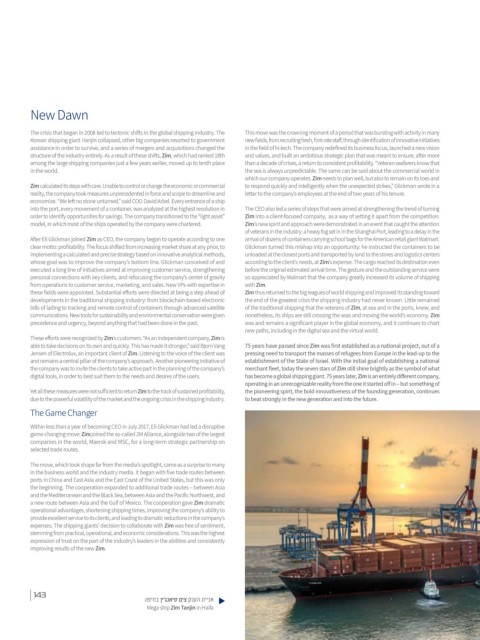
אניית הענק צים טיאנג’ין בחיפה
Mega ship Zim Tanjin in Haifa

