


Page 37 - ZIM 80
P. 37
After 2000 Years Reparations and Transformations
In 1953, when the old ship Atzmaut – named after the illegal immigration ship that had In 1953 the State of Israel was reeling over the decision to accept war reparations from
been decommissioned just two years earlier – reached the port of Cape Town, its crew Germany – compensation, if only material, for the crimes of the Nazis. The controversy
could not imagine the enthusiastic welcome that awaited them. Adoring crowds of was fierce, but once the decision was made it had to be put into practical terms. More
hundreds of people awaited them at the port; the sailors were given the royal treatment, than any others, Zim’s management and Board of Directors prepared a detailed plan
with fancy receptions and interviews in the local newspapers. When the ship Tamar docked for investment in ship building, equipping and renewing the Israeli merchant fleet. Zim
in Detroit in 1959, the local newspaper published a headline in Hebrew: “To the captain board member Hillel Dan (who was also the director of the “Solel Boneh” construction
of the Tamar and its sailors, bo’achem leshalom acheinu bnei yisrael – Come in peace, and infrastructure company) was among the enthusiastic proponents of implementing
our Jewish brothers!” The newspaper described the arrival of the ship as a “miracle in the ambitious plan. He was appointed to lead the reparations delegation to Germany.
the chain of modern miracles.” Similar scenes could be witnessed throughout the 1950s, The ship building plan was of great interest to the German shipyards as well, where they
when Zim’s ships made their maiden voyages to ports with large Jewish communities. were hungry for work.
The sailors found the daily grind of work pushed to the side and themselves drawn into
a rising tide of excitement and burning national sentiment. More than a few love stories The period following the signing of the first phase of the reparations building program
blossomed between the young sailors and the ecstatic young Jewish women. with Germany was a formative period for Zim. A ship design and engineering department
was founded, in which cohorts of professionals were trained, including ship engineers
Israeli ships in those years were much more than a commercial affair; in the eyes of world and other experts. In order to plan the company’s new strategy, with the introduction
Jewry and those sympathetic with the young State of Israel, they were no less than a of the new ships, they would have to hire and train a battery of professionals who could
floating realization of the Zionist dream. Within just a few years of intensive shipping leverage the great opportunity of renewing and expanding the fleet.
activity, the distant, wild dream of a Hebrew fleet flying the Israeli flag became a reality.
Zim ships visited more and more ports around the world and expanded their routes, Not everything was rosy, however. Financial considerations, commercial competition,
though the fleet was old and small, and resources were scant. The crews had to rely on and government intervention in the process led to bold, sometimes hasty, decisions
their resourcefulness and ingenuity to overcome seemingly insurmountable challenges that ultimately weighed on the company; we should recall that Zim did not receive
during their voyages. For example, when the Avraham Graetz, under the command of direct reparations payments, but only favorable terms and guarantees; at the end of the
legendary Captain “Ike” Aharonovitch, the captain of the Exodus, ran out of fuel, the crew process Zim paid the full cost of the ships from its own budget.
powered the boilers by burning the wooden covers of the ship’s hulls so as to avoid the
towing fees, which were higher than the value of the ship itself. In 1955, in Benin in western Development came “at a dizzying pace.” The average age of Zim’s ships dropped drastically;
Africa, the crew of the Atzmaut, under the command of Captain Zono Edelstein, replaced if before the building program the average age of a ship was 20, by the end of the second
the ship’s propeller (a difficult and rare operation) without docking or coastal facilities. stage of the reparations almost 75% of the company’s fleet was comprised of ships
under five years old. Zim’s growth was tremendous – not organic and gradual but in a
The dedication and professionalism of the crews did not hide the fact that the old cargo single leap – transforming within just a few years into a company of impressive scope.
ships could hardly stand up to the task of building an efficient and profitable commercial Thousands of Israeli sailors joined the merchant fleet and Zim started to make its mark
fleet. The fluctuations of the international shipping industry, of which the company had on the international shipping industry. This energetic pace of development wasn’t slowed
become part with the development of its new routes, also had to be contended with; by the crisis of the global shipping industry in 1957, although the company’s financial
refurbishing and expanding the fleet was an urgent need. situation was complicated due to its many investments. The solution was to bring the
Israeli government in as a partner in Zim. And thus the company’s Board of Directors,
Likewise in the passenger ship branch, Zim’s directors had to deal early on with a comprised of representatives from Zim’s founding bodies – the Jewish Agency, the
fundamental strategic shift. Specifically, the great wave of Jewish immigration of the Histadrut Labor Union, and the Israel Maritime League – was joined by representatives
first years of the state had naturally waned and the former immigrant ships – which had from the government. The organizational and managerial structure of the company
been dubbed “distinguished ladies” – no longer suited the new type of passenger: business underwent a reform, and at the end of 1962 Dr. Naftali Wydra was appointed the first sole
people for whom sea travel was the most readily available means of transportation before CEO of the company, which until then had been run by four co-directors.
the development of mass air travel, and in particular tourists and vacationers. The albeit
fast-growing but still inexperienced company had to adapt to this new situation, which At first it was general cargo ships that were built in the framework of the reparations from
demanded much higher standards that the old ships couldn’t stand up to. Germany, and later also specialty ships such as bulk carriers and gas and oil tankers. But
the jewel in the crown was the refurbishment of the fleet of passenger ships, which was
רשימת נוסעים מהפלגתה של to a large extent the focus of public attention. The Theodor Herzl was the most modern
1959האנייה ציון ב־ and luxurious of the passenger liners built in the framework of the reparations, and its
maiden voyage through the ports of Europe in 1957 was a remarkable public relations
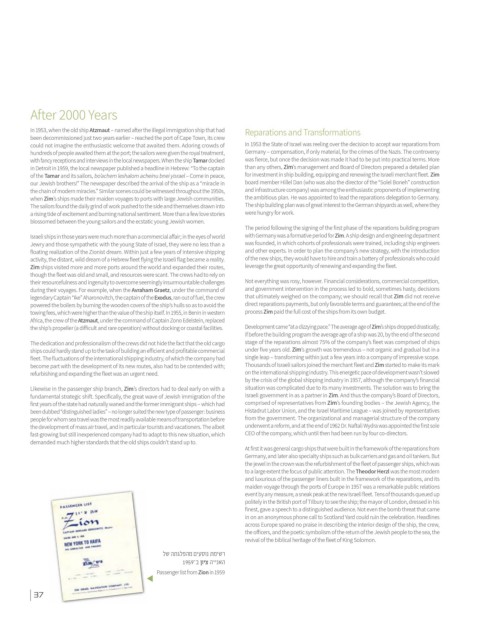
Passenger list from Zion in 1959 event by any measure, a sneak peak at the new Israeli fleet. Tens of thousands queued up
politely in the British port of Tilbury to see the ship; the mayor of London, dressed in his
37 finest, gave a speech to a distinguished audience. Not even the bomb threat that came
in on an anonymous phone call to Scotland Yard could ruin the celebration. Headlines
across Europe spared no praise in describing the interior design of the ship, the crew,
the officers, and the poetic symbolism of the return of the Jewish people to the sea, the
revival of the biblical heritage of the fleet of King Solomon.

