


Page 81 - ZIM 80
P. 81
The Pacific Star In Japan The program was complex, global in scope, and demanded many strategic
decisions: building a container factory at Kibbutz Giv’at Brenner, procuring chassis
Toward the end of the 1960s Zim went through a series of upheavals and changes in and operational equipment, signing contracts with terminals, establishing a huge
management. In addition to the blow they took in the wake of the Shalom collision, operational, administrative, and commercial network to support the new service. But
Zim’s famous passenger lines were fighting a losing battle in the new era of affordable the most critical decision was to commission container ships especially for the line.
civilian air travel. Even if there were already container ships working in different places in the world,
Zim was the first to build a series of modern container ships to serve a designated,
By the end of the decade the passenger lines shut down for good, to the great sorrow meticulously planned line. The ships were built in the Italcantieri shipyards in Genoa.
of many. The tantalizing splendor of its love boats may have gone, but a grand new The first two ships, whose construction was funded in part by Germany, flew a German
challenge awaited the company. Moshe Kashti, who replaced Meir Giron as CEO in flag, and its crew included German officers and Chinese sailors; but immediately
1970, gave the go-ahead to a project initiated by a few enthusiastic young members afterwards Zim Haifa and Zim Genoa were built. These ships flew the Israeli flag and
of the company (In Zim they were known as “the doctors.”) with a massive investment had a 100% Israeli crew. In 1973 two more ships were built, this time in Germany, at
of over 300 million dollars. These “doctors” thought big, and they were about to the Bremer Vulcan shipyards – Zim Montreal and Zim Hong Kong – which flew a
change Zim for good. Liberian flag and had an Israeli crew. The six ships rounded off Zim’s container fleet,
ZCS, whose new logo was painted conspicuously on the ships and the containers.
It had begun almost a decade earlier with the Pacific Star Line: Zim was already an The service was later enhanced with the addition of a seventh ship – Zim California.
international company operating ships far from home. In 1961 a line was inaugurated
that would serve the booming commerce between the USA and Japan. Ships such ZCS’s ships were brand new; for the officers and crews this was a brave new world, but
as the Ampal, Negbah, Deganya, and Tverya crossed the Pacific, providing excellent not always a better one. Modernization did not reach every aspect of the operation.
service by the standards of the mid-sixties. Zim established a headquarters in Japan, Stability calculations were still done by hand by the ship’s officers; the officers had
first in the port city of Kobe and later in Tokyo. They built ships in Japan and set up no experience in operating this type of ship, yet they were charged with crossing two
a maintenance and repair center, with business growing at a steady pace. By the oceans and a route of approximately 65,000 kilometers, one and a half times the earth’s
end of the decade, however, the troubles began: the ships were getting old and the circumference, on every voyage, and on a strict timetable to boot. Navigation was
competition was catching up, offering more regular and frequent service. The line done with traditional methods until satellite navigation tools were finally installed
began to suffer losses. on the ships. In the first years, not all ports had a container terminal. In Hong Kong,
for example, the ships were unloaded using regular cranes – to the pleasure of the
The Zim management appointed a team, headed by Captain Izzy Edelstein, with Dr. sailors, who enjoyed the longer stay in the port. But soon enough they had to adapt
Yoram Almogi and Avraham Ben-Yehoshua, to address the matter. In 1968 they held to a new reality: lightning quick layovers, mostly at a terminal far from the city, as
a conference in Japan where the team presented alternatives for the future of the was becoming the norm in modern shipping.
Pacific Star Line. The findings of the research were clear: containers were the choice
of the future. This was a bold recommendation, if only because another pioneering The years of the establishment of the container service were accompanied by fateful
experiment in running a container line, that of the Sealand Company, was on the events for the State of Israel, alongside internal upheavals in the company. In October
brink of failure. Some experts believed that container shipping was a bad idea and 1973 Israeli society and resources were mobilized to the Yom Kippur war effort. A
that it would not stand the test of time. On the other hand, from the beginning of the short time later, in March 1974, the sitting CEO Kashti died suddenly; board chairman
1970s the Japanese establishment had been convinced to create the infrastructure Michael Zur was charged with financial crimes and sent to prison; former chief of staff
necessary for a container service and was enthusiastically implementing the idea. David Elazer, who had been appointed chairman of the board, also died unexpectedly
At Zim they were aware of these developments; this doubtless helped them reach in 1976. Throughout all of these upheavals the people at Zim stuck to the task of
the decision to establish Zim’s container service. The first stage of the project was establishing and developing the container service, which became the foundation for
to replace the Pacific Star Line ships with a container fleet and all the corollary Zim’s operations for decades to come. The container revolution changed the face
infrastructure. An ostensibly modest goal that in reality spelled revolution. of shipping and the face of international trade, and Zim played an important and
pioneering role in this revolution.
New Ships for a New World
1981 ב־, מאניות הדור הראשון,צים סוואנה
The project team ran into much skepticism, both within the company and beyond.
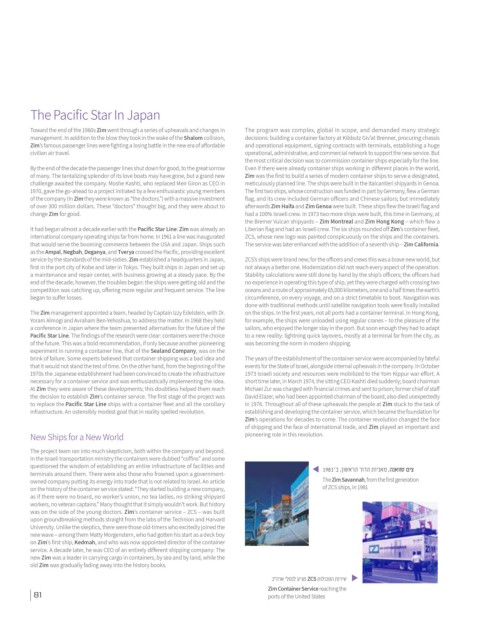
In the Israeli transportation ministry the containers were dubbed “coffins” and some The Zim Savannah, from the first generation
questioned the wisdom of establishing an entire infrastructure of facilities and of ZCS ships, in 1981
terminals around them. There were also those who frowned upon a government-
owned company putting its energy into trade that is not related to Israel. An article מגיע לנמלי ארה"בZCS שירות המכולות
on the history of the container service stated: “They started building a new company, Zim Container Service reaching the
as if there were no board, no worker’s union, no tea ladies, no striking shipyard ports of the United States
workers, no veteran captains.” Many thought that it simply wouldn’t work. But history
was on the side of the young doctors. Zim’s container service – ZCS – was built
upon groundbreaking methods straight from the labs of the Technion and Harvard
University. Unlike the skeptics, there were those old-timers who excitedly joined the
new wave – among them Matty Morgenstern, who had gotten his start as a deck boy
on Zim’s first ship, Kedmah, and who was now appointed director of the container
service. A decade later, he was CEO of an entirely different shipping company: The
new Zim was a leader in carrying cargo in containers, by sea and by land, while the
old Zim was gradually fading away into the history books.
81

