36
ZIM MAGAZINE
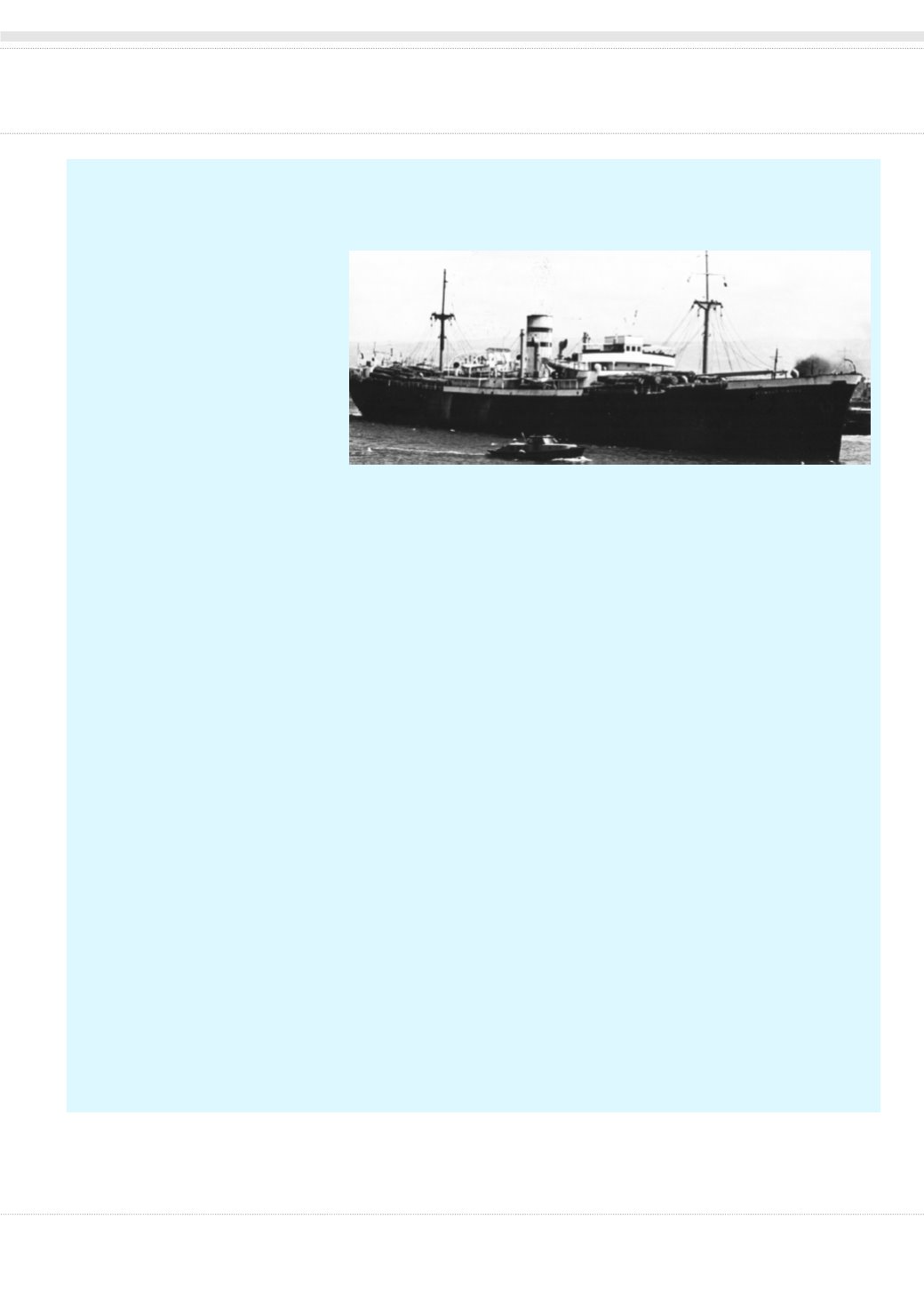
The
ATZMAUT
—the second ship bearing
that name—came to ZIM in March 1953.
She had a loading capacity of close to
10,000 tons and sailed with cement and
general cargo toWest Africa, where she
loaded up with timber for Israel. Her
time with ZIM was short, and in 1956
she was sold, probably for scrap. One
day in 1955, she was supposed to enter
the river estuary in Benin en route to the port of Sapele
in Nigeria with 500 tons of cement and to load up with
timber for Israel. When she approached the estuary, at
around 17:30 hours, unusual strong tremors were felt on
board ship. The tremors were a clear sign of a serious fault
with the propeller. The ship stopped, dropped anchor,
and Captain Zono Edelstein requested that a ladder be
prepared for him at the stern. He went down the ladder,
looked at the place where the propeller ought to have been,
and climbed back to the deck. Among the crew gathered
in the stern was the Chief Engineer, a Frenchman. The
Captain addressed him in French: “Il n’ya pas” – “it’s not
there”. The propeller had broken off and sunk. Two tugs
were called from Lagos port, a distance of around 100
miles. After some discussions, they came to the agreement
that the ship would be towed to the harbor at Lagos, for
standard towing fees only.
The ship had a spare propeller and a tail shaft. Propellers
are usually replaced on a dock, but no port in the vicinity
had a dock and certainly not of the size that could take
a ship of 10,000 tons loading capacity.
There are very few cases known of a ship’s crew replacing a
propeller themselves, but the Captain and the crew decided
that the entire crew, the officers and the rank and file from all
departments would undertake this job. The ship had about 20
local workers who loaded the timber. With their help, 500
tons of cement bags were transferred from the stern cargo
hold to the front cargo hold, which lifted the stern and the
severed propeller above the water line. When it was time to
transfer and assemble the propeller, the Captain decided to
do this with the help of a floating crane, because of the risk
involved in the operation. The crew built a floating platform
from empty barrels at the stern of the ship and the floating
crane lifted the propeller into place. This was the only task
that was not carried out by those on board ship. After three
weeks, the
ATZMAUT
returned to service. Among the crew
who served on this voyage were Captain Zuno Edelstein, Chief
MateYaakov Zaid, Second MateYulian Ronen andThird Mate
George Neugeborn. The engineers were the French Chief
Engineer; Kurt Hollander, First Engineer; Amnon Garbash,
Second Engineer; Razi Baswicz, Third Engineer; Aharon
Zuker, Boatswain; and Menachem Krigel, Donkey Man.
Source: Menachem Krigel, Amnon Garbash
The ATZMAUT’s propeller replacement


