


Page 11 - ZIM 80
P. 11
Finally, a Ship Tragedy and Hope
Bar Kochba Meirovitch, a Rishon Lezion native, was not versed in the manners of the In those same days the headlines were filled with the story of the immigrant ship Exodus,
British aristocracy; small talk about horses and hunting dogs were not a part of his which stirred international public opinion and became a turning point in the struggle
lexicon. Nonetheless, in 1946, when he negotiated in London with Lords Wimborne and to establish a state. The sweeping illegal immigration campaign, operated by the “Aliya
Kilmarnock on behalf of the Zim shipping company, which had been established a year Bet” branch of the Haganah underground, created a new national myth. Its operatives
prior, he achieved the desired result – a cooperation agreement for the procurement of ran a “shadow fleet” and gained maritime and shipping experience through circuitous
a ship. The telegraph he sent back home was received with a sigh of relief mixed with and obstacle-ridden routes. Upon the establishment of the state, this huge operation
excitement: finally, a ship. turned at once from an “illegal” enterprise into the foundations of a commercial fleet
that would serve the newly founded state. At the end of the complex process, the step,
The official establishment of Zim in 1945, immediately following the Second World War, which in hindsight looked like a natural one, was completed: merging the management
was a historic step, but its founders faced an impossible mission: building a shipping of the young Zim company with that of the Aliya Bet organization.
company from nothing, within an almost chaotic reality. “We very much wanted our
ships to be visible on the Mediterranean immediately after the war,” said Meirovitch, later Zim’s ranks were thus joined by the clandestine forces behind the immigration mission.
Managing Director of the Transportation Ministry; but during the war a large part of the Among the senior members of the organization were those who during the years of the
international merchant fleet simply drowned. The conflict between the Yishuv, striving campaign gained expertise in the procurement and operation of ships while managing
for independence in the Land of Israel, and the British Mandate, was escalating. This an expansive international network of agents and representatives: much like the directors
made purchasing a ship all the more difficult. of the shipping company, but a little different. Yosef Barpal and Zvi Yechieli were among
the prominent names joining Zim’s management. Further joining the company’s ranks
Not until the end of the 1930s did seafaring receive any attention from the side of the came graduates of the Palyam underground maritime courses of the Haganah, as well as
Yishuv leadership. This would change fundamentally in the years leading up to the British navy veterans who had seen battle at sea and gained experience in transporting
establishment of the state and during WWII. Right after the War, in light of the sheer supplies and fuel in a sea riddled with enemy submarines.
scope of the Holocaust of European Jewry, the Yishuv began to make massive rescue,
escape, and immigration efforts. Quintessential of this merger were the two largest immigration boats, Pan York and Pan
Crescent. The ships were intercepted on their way to Palestine and taken to Cyprus. The
The British navy prevented the arrival of immigration boats packed with survivors to immigrants were taken to detention camps while the crews, under the command of Ike
Palestine, causing anger, frustration, and a yearning for a different future. During these Aharonovitch and Gad Hilb, remained on board and anchored near Famagusta, where in
years there was a growing recognition of the importance of independent shipping, and mockery of the British they kept the vessels in seafaring form and ready for action. Just
it was no longer just a matter for enthusiasts. A refrain by poet Haim Gouri, opening with as Israel’s declaration of independence took place, a flag-raising ceremony was held on
the words “The day will come my brothers,” captured the collective spirit in an almost the deck, in which the great Cypriot friend of the immigrants, “Papa,” after whom a city
prophetic statement: A Hebrew fleet will sail, my friends / and in the light of the afternoon square in Haifa was eventually named, took part. Both of these ships became part of
sky / it will be like every land and nation! the young Zim fleet under new names, Atzmaut and Komemiyut, and they carried the
released detainees from Cyprus to Israel.
To the effort Zim’s founders tried to mobilize all of the private and institutional maritime
players in Mandatory Palestine, with the goal of forming a unified front for the establishment In a relatively short period of time more boats were purchased – Negbah, Artzah, and
of a national company. It wasn’t a simple task, despite the feverish activity in response Galilah – which carried on board the massive wave of immigration during the first years
to the distress of hundreds of thousands of refugees in Europe. At one of the heated of the state. Each boat has a story of her own; from their decks thousands of people
meetings leading up to the purchase of the first ship, Zim reported about the company’s entered Israeli territory and beheld Haifa and the Carmel Mountains for the first time.
efforts and was criticized for being too fastidious in its search for a suitable ship: “It is
better to make mistakes than to begin with nothing,” stated Captain Zeev HaYam, one In parallel, Zim worked energetically to develop cargo routes to Europe and America, to
of the pioneers of shipping in Israel. establish an operational infrastructure and subsidiaries, and to appoint ship agents in
the various ports of call. The scope of the activity in the first years was dizzying, as was the
And indeed, there were efforts (which luckily did not yield results) to purchase ships that series of dramatic events that took place during them. In 1951 came the great seamen’s
turned out to be either unseaworthy or not suited for their designated purpose. But the strike, a formative event in Israel’s history; Zim, while not playing a main role in the story,
agreement that Meirovitch finally reached with the owners of the British Harris & Dickson was nevertheless impacted by its results. In 1952 Zim purchased the Dizengoff shipping
company to purchase and operate a vessel named Kedah, was different: The ship had company, inaugurated an independent route to America, and showed impressive growth.
an illustrious record, and even though it was in need of a complete overhaul, it was a The flow of immigrants thinned, and passenger ships started to focus on fare-purchasing
splendid vessel. Zim changed its name to the more apt Kedmah, meaning “Eastwards.” travelers and tourists.
The saga of its purchase and renovation, and the training of the first crew, were an endless
source of pioneering tales and nostalgia. The arrival of the Kedmah at the Tel Aviv Port, It was one of Zim’s founders, Gusta Strumpf-Rechav, who clearly expressed the dilemma
on July 28, 1947, after quite a few hardships and mishaps, took on the form of an epic – and the strategy – of Zim as a national shipping company: “Our primary role is Jewish
national event: “A symbol of solace, renewal, a covenant with the sea,” wrote historian immigration. But there is no contradiction between the national and the economic.
and director Zvi Herman. The heads of the Yishuv came to greet the ship, and journalists Our company must have a commercial rationale and not lose money.” The implied
enthusiastically described the passengers and crew. contradiction between national and commercial goals would accompany Zim for many
years to come.
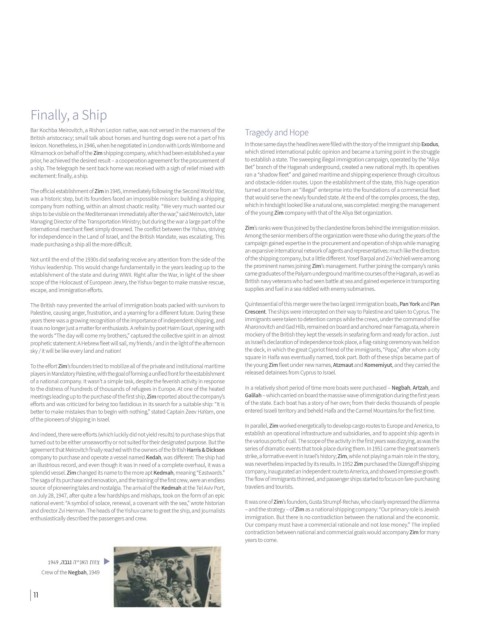
1949 ,צוות האנייה נגבה
Crew of the Negbah, 1949
11

