


Page 93 - ZIM 80
P. 93
Unions, Oil, and Geopolitics Distress Signals
On April 6, 1977 the Israel Sea Officers’ Union announced that Zim’s ship Tilia would The series of crises of the late 1970s took place on the backdrop of a recession in the global
not depart on its scheduled Mediterranean voyage due to a dispute over a clause in shipping industry. Notwithstanding, at the beginning of the 1980s Zim’s fleet numbered
the work contract. A minor event, so it seemed; the turbulent relationship with the some one hundred ships operating on dozens of routes around the world. The container
officers’ and sailors’ unions – perhaps a legacy of the seamen’s strike of 1951 – was a lines were thriving, alongside the general cargo lines and bulk carriers. Despite the deep
constant for Zim’s management. Almost 80 days later, however, it was clear that this crisis it seemed that the company was slowly but surely returning to sail on peaceful
strike was no less formative an event than its mythological predecessor. By the time it waters, when Zim was struck in March 1981 by the Mezada disaster.
ended, many accepted truths in the Israeli shipping industry had fallen by the wayside.
Almost miraculously, throughout more than three decades of intensive activity, Zim had
The public mood this time was completely different: few were aware of the nuances of never been struck by a major maritime disaster. The Mezada, which was built in Germany
the arguments of either side, not to mention the difference between officers and other in 1960, was carrying potash cargo from Ashdod when it got caught in a violent storm near
ranks, but the damage to the economy was clear. Zim CEO Yehuda Rotem, a member Bermuda. It is chilling to hear the recording of wireless officer David Steier broadcasting
of Kibbutz Sedot Yam and former director of the Kibbutz-owned shipping company a short time before abandoning the ship into the turbulent sea, where he was lost: “The
Tarshish-Sela, led the negotiations, which ended in a complete reorganization of front holds are flooded,” he reported to the coastal station in Bermuda. And after that to
the troubled relationship with the unions. The damages were great, but ultimately the coastal station Radio Haifa, in Hebrew: “The situation is getting worse, it looks like we’ll
“industrial peace” was attained, not only for Zim, but in labor relations throughout have to abandon ship.” The Mezada tragedy is a saga of a desperate human struggle for
the shipping industry. survival at sea; for the eleven survivors, the struggle ended in a sad victory: twenty-four
of their fellow crewmembers fell victim to the turbulent sea. This was the worst maritime
Zim’s work was not limited to the Israeli home court, however; the company was disaster ever to strike Zim and the Israeli merchant fleet. For the Israeli public it was a
impacted by global developments, sometimes significantly. 1977 was the year in reminder that even in the modern, mechanized era, sailors must deal with the forces of
which the peace agreement between Israel and Egypt was signed. The Suez Canal nature, just like generations of seafarers before them. At Zim, a big-small company, where
had dictated the national and international agenda at several key historical moments, everyone knew everyone else, the disaster was a terrible, heartbreaking trauma. The
with freedom of passage of Israeli ships providing a pretense for two wars; for years entire organization came together to mourn and to support the families of the victims.
Zim’s international routes had been planned without taking the Suez Canal, which was The loss of the Mezada, and the lessons learned from the incident, led to a revamping
blocked to Israeli ships, into account. It is no wonder, therefore, that the first passage of the professional and technological preparedness of the fleets for decades to come.
of an Israeli ship through the canal was an exciting event: the crew of the cargo ship
Ashdod, chosen to make the maiden voyage across the canal flying the Israeli flag, The tragedy was a painful blow at an already difficult time. Although the development
had a feeling of making history. Upon entering Egypt’s territorial waters, an Israeli and procurement programs continued – in 1983 four ships came into service – the global
sailor, Egyptian-born, hoisted the Egyptian flag on the mast alongside the Israeli flag. recession in the shipping industry went on for much longer than estimated and the
Ships in the Suez Gulf sounded their horns in honor of the Ashdod, and thousands situation continued to deteriorate. “A terrible storm,” as it was dubbed by the outgoing
cheered from the coast as the ship passed by Port Said. The homecoming in Israel was CEO, Rotem. The terminology remains familiar even decades later at Zim: oversupply,
no less enthusiastic, with headlines in the newspapers and a festive reception for the freight rate drops, fuel price hikes. The accepted wisdom among veteran shipping people
crew. At Zim there was cautious optimism about the new possibilities that presented was that whoever manages to survive the crisis will get to enjoy the high tide – but it was
themselves with the opening of the canal. slow in coming.
In 1979 came the revolution in Iran, a geopolitical earthquake whose aftershocks can In 1984 Matty Morgenstern was appointed CEO. He had made his way from junior
be felt to this day. Pre-revolution Iran was a friendly nation and a major oil exporter. The crewmember to the top of the organization. He gathered the staff of the company in the
regular supply of oil was of utmost national interest, and Zim began to operate tanker Shavit Cinema in Haifa. “There is room for anxiety,” he said, “but not for defeatism.” The
ships as early as the late 1950s. Its first tanker, the Haifa, had a volume of 30,000 tons. company embarked upon a series of steps, which included, alongside downsizing and
in 1959, the Patria was built at the Uraga shipyards in Japan; that deal was brokered by economizing, also aggressive tactics – “a war to the finish,” in the words of the new CEO,
a Tokyo resident named Shaul Eisenberg – later the principal shareholder in the Israel to fend off the damage of the wild competition and the wasting away of freight rates.
Corporation and in Zim. But these were only the first blossoms of the wild growth of These brought about a dramatic improvement in the state of the company. The storm
the oil tanker industry, and in the size of the tankers, which would evolve into giant sea clouds gradually cleared, and Zim began to make plans for the future.
monsters – the largest mobile structures ever built. Zim’s Tankers and Bulk Carriers
Division operated the super tankers and trained a generation of experts in this specialized
branch, which for many constituted a kind of “Wild East” of the shipping industry.
Due to security concerns, among other things, the tankers had encoded names and
were registered under foreign companies; the exotic name of the Roniz, for example,
was the Hebrew word for “pipeline” (zinor ) spelled backwards. The tankers were a
target of terrorist activity, and in 1973, Zim’s ship Siris hit a naval mine; the crew was
unharmed. Zim’s vast tanker operation was cut off at once with the outbreak of the
revolution in Iran in 1979. Within a short period of time the era of the oil tankers in the
Israeli merchant fleet came to an abrupt end.
1969האנייה לאה ב־
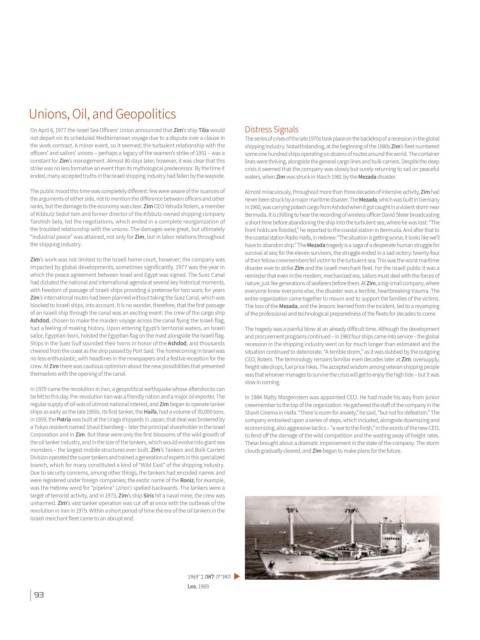
Lea, 1969
93

